Thursday, April 5, 2012

In which we find terra cotta, frescoes, and tirimisu

Yesterday we started off with a trip to a terra-cotta manufacturer in the area called MITAL. As is par for the course, the map didn't match the directions, so we drove in the general vicinity of the place we were trying to find, then ended up somewhere entirely different.

We found a guy who does incredibly creative things with clay, all one-of-a-kind and simply gorgeous (above). We ended up purchasing a wall plaque from him that depicts a scene of the Tuscan hills, with a monastery in the background.  Of course the plaque was wrapped before I had a chance to take a picture of it, so I'll just have to post it after we get it home and hang it on the patio wall.

 Naturally, we then had to visit the monastery in the scene, Certosa.

 The monastery was built directly on the bedrock of the hill - it was pretty cool to see the chunks of hillside integrated into the building!

 Apparently even monasteries needed defensive measures - check out the arrow slit!

 Next off, we headed to San Gimignano, also known as the City of Towers.

The old part of the town is pedestrian-only, which is pretty nice after a dodging crazy Italian drivers. Here's a cool tiny narrow alley side street with an archway.

This picture was taking standing in front of the Duomo, in the main piazza. The town originally had at least 72 towers - I think there are about a dozen towers left. Apparently the wealthiest families liked to build tall towers to demonstrate their wealth and influence (apparently a medieval version of "mine's bigger than yours").

 San Gimignano is a city full of 13th century frescoes. These are in a courtyard. Love the covered staircase too!

Almost every available surface of the inside of the Duomo is covered in more 13th and early 14th century frescoes. The black and white stripes are marble typical of the area.

 An illicit photo of one of the incredible frescoes (ssshhhh!). This one is of the Roman soldiers at the Crucifixion.

After the duomo, the hubby wanted to follow the signs to see the castle ruins. The problem castle ruins is that they are ALWAYS at the top of the hill. That's a lot of steps for a view - even if it is a really good view!

 At the end of the day, we were hungry and looking for a place to eat on the way home. We unexpectedly ran across the Gabbiano winery, so we decided to stop for dinner. (We have a long history with Gabbiano wine. It was the first wine I brought to a dinner that hubby cooked, and today is our 5.5 year anniversary. It seemed fitting!)

Our truly decadent meal was topped by an amazingly rich tirimisu covered in candied pistachios and chocolate slivers. Mmmmmm....

Wednesday, April 4, 2012

Pictures of today

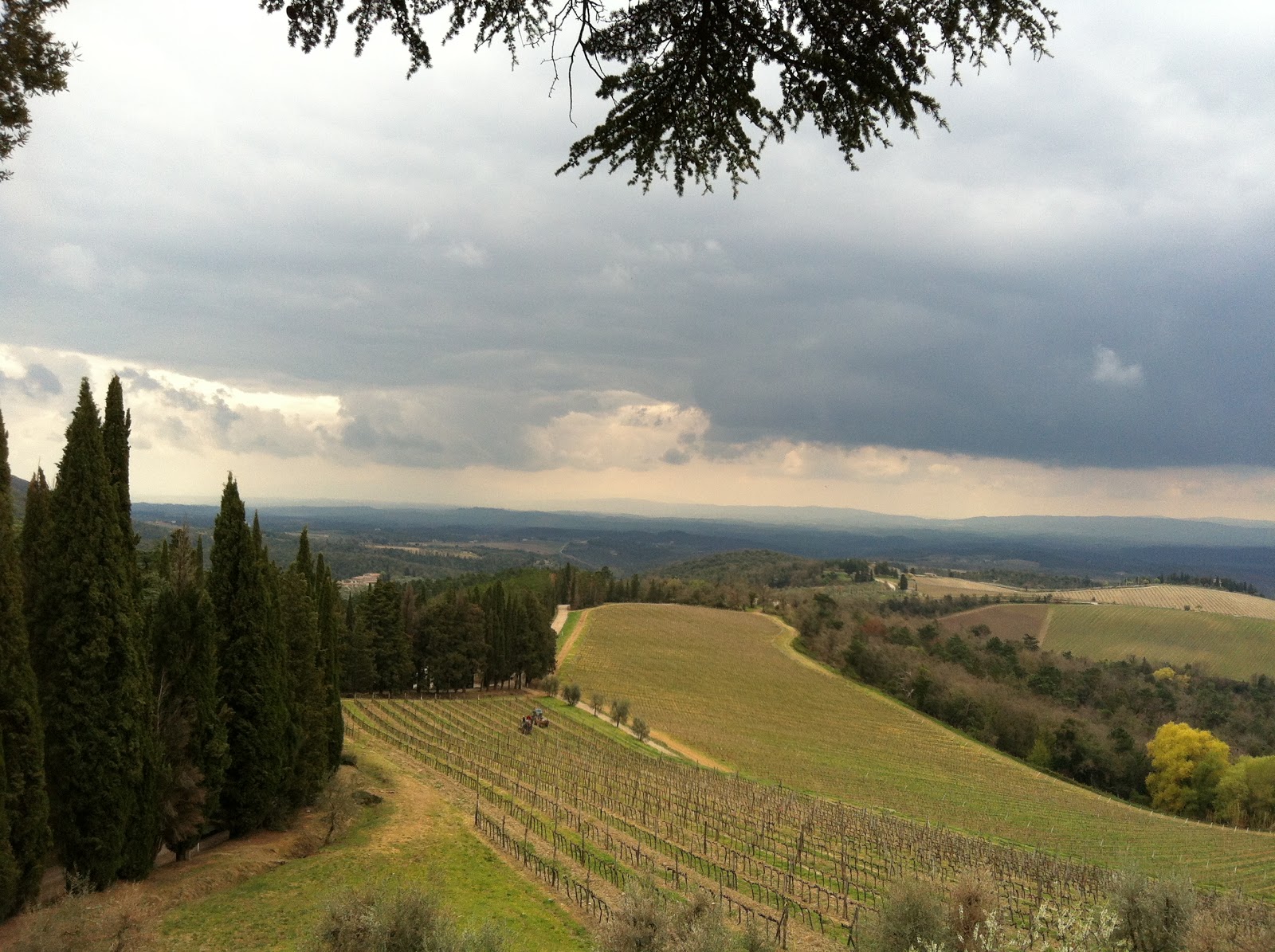
 Tuscan countryside.

 The original tower, built in the 11th century, of Castello di Brolio.

 Hubby at the entrance to the castle gardens.

 The chapel for the castle, with the tower on the left.

More of the castle - you can see where the stone changes color is where they built an addition.

 View to the south from the castle wall.

View north-west from the castle wall. The castle was a very strategic point - its owners backed the Florence republic, and Florence was constantly at war with Siena. You can see Siena from here, so they could always see if there was an army marching out from Siena!

The family that owned the castle did an extensive brick addition in the 1800s (the same family built the original castle in the 11th century). They tried to make the style match the original castle - it's called the "neo-gothic" style.

Hubby checks out the castle's defenses - arrow slits!

We are getting much better at parking our car. Note the classy job where we're half on the sidewalk (no kidding, this is how they park over here!)

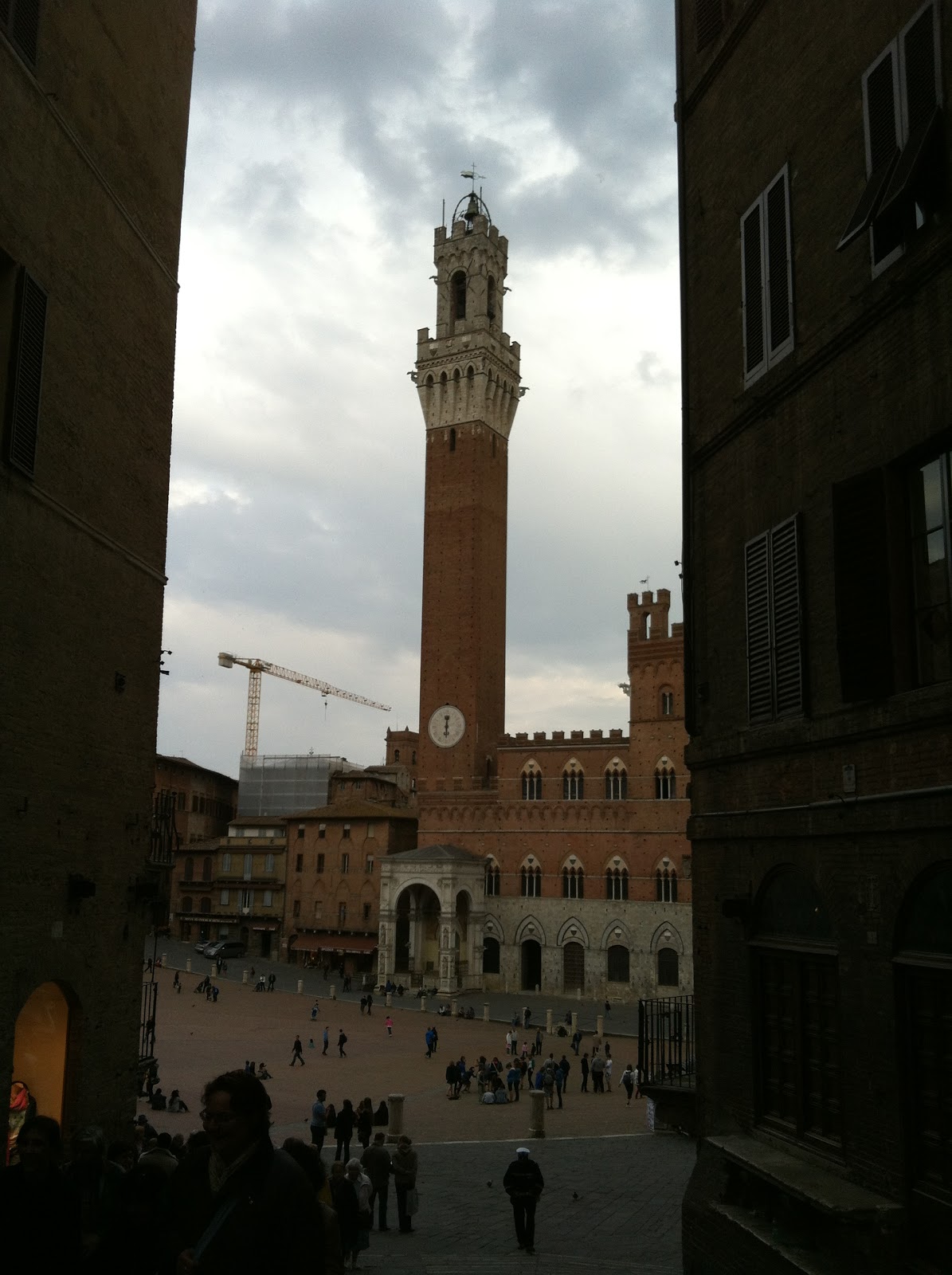
Next, we visited Siena. This is the central Piazza il Campo, with the Palazzo Pubblico. This Palazzo housed the town hall for hundreds of years, and is full of beautiful frescoes from the 13th and 14th centuries. The tower on the left is one of the tallest in the world of its type, built in 1296. Incredible!

One of the many frescoes, showing how the Italians defeated Frederick Barbarossa of Germany.

View from the Palazzo.

The Duomo in Siena, 13th - 14th century. It's famous for the black and white marble stripes, which are also all over the inside of the cathedral.

Inlaid marble walkway outside of the Duomo.

The bapistry around the back of the duomo. The doors are original, built in 1345.

Cool shot of the Piazza il Compo and the tower in the background.This Piazza is the start and the end of the famous bareback horse race in Siena!

Monday, April 2, 2012

Firenze (Florence), day 1

First things first. If you are planning to visit Italy, DO NOT RENT A CAR.Take the bus, the train, a taxi, or WALK, but unless you want to spent the majority of your time clutching the "oh shit" handles in the car (if you're the passenger), or yelling "oh shit" as you are passed by Vespas and buses while going 70 km going down mountain roads with hairpin turns (if you're the driver), stick with public transportation. Really. I'd take a video to share the excitement with you, but I'm too busy hanging on for dear life.

ANYway, we did make it from our agrotourismo to Florence with not one wrong turn! We had excellent directions and a carefully hand-drawn map, so that helped a ton. We spent the day wandering around Florence and taking in some of the sights.

 The front of the Basilica di Santa Maria del Fiore, the major cathedral in Florence. Each bit of color you see is inlaid marble, in pink, green, and the white Carrera marble. This picture doesn't do it justice - it is simply incredible in its complexity. The inside of the cathedral is austere in comparison.


 The bell tower for the duomo. It's been painstakingly cleaned and restored and today the colors of the marble are quite brilliant.

 We saw perhaps the most incredible private armor collection we've ever seen today at the Stibbert museum. There were thousands of pieces of armor, mostly from the 16th century. What made the collection so special was how complete the pieces were - many had the original linen linings and leather buckles. What's on display in many museums is parade armor, whereas this collection was more everyday jousting armor. Unfortunately, this was the only picture we were able to take - all the rest was off-limits to photography. We are hoping to go back later in the week and actually be able to photograph some of the pieces, with the director's permission. Fingers crossed!

 One interesting thing we saw in the Stibbert museum/house was that much of the "marble" is actually wood painted to look like marble, as was this door frame.

 Another basilica in Florence. This one was interesting because it has the same detailed inlay on the front, but you can see that around the sides is just plain brown stone. The marble is all a facade!

 Hubby and I on the Ponto Vecchio (old bridge). The bridge was first built over a thousand years ago!

View down the Ponto Vecchio. The bridge is completely lined with goldsmiths' and jewelers' shops - you can't even see the water except in the middle!

 Up-close of a goldsmith's shop.

The Uffizi Palace. This was the home of the Medici family, but today houses an amazing collection of art collected by the family. It's closed on Mondays, so we're planning to go there tomorrow.

 And you thought SmartCars were small! I'm pretty sure this is the Flintstones version of a car!

That's all for now. The report from home is that the boys are well and keeping out of mischief. I have such excellent housesitters (you know who you are!)

Sunday, April 1, 2012

Ciao from Italy!

I don't often blog while on vacation, but I have shockingly good internet right now, so here goes!

Currently the hubby and I are in an agrotourismo about 20 kilometers south of Florence, Italy. The view is nothing but olive trees, vineyards, and extremely quaint towns with red-tile roofs.

 
The trip started in Central Texas, with a "last meal" of a loaded baked potato smothered in chopped brisket and BBQ sauce. Only a few dozen calories, I promise!

Next stop, London-Heathrow airport. All boarding to Pisa! (Nic, I waved in your general direction from here.)

Upon arriving at Pisa, I had to drive 70 kilometers north to meet my husband at a conference. It only took me 4 long, painful hours to make the trip. First, I had a detour to the east of Pisa (instead of west; silly me for following the signs), and then I got completely lost in Lucca, which is to the north. The map I had sucked, as none of the roads on the map were actually labelled. The directions I had were worse than useless, with instructions like "turn left on the Via della M. Civilite" - you see, in Italy all of the street signs are in tiny print on the corner of buildings, quite invisible from the main road - that is, if they exist at all! ARGH!

 
At one point I pulled over to check my map and directions, and then could not figure out how to get the fucking car into reverse to get out of my parking space. Tell me, how does this work? I ended up having to piece it together from the instruction manual in the car, which is in Italian. Have I mentioned that I don't actually speak or read Italian?

I tried to ask for directions multiple times, but it was during afternoon siesta (2-4 pm) so nobody was about. Of course my phone also doesn't work in Italy, except for texts, so my poor husband got texts with an ever-increasing number of four-letter words as I got more and more desperate.

 
I did finally make it to the hotel, where I took a very long, very hot shower with the contents of these bottles: Happy, Alive, Happy, Calm. Yep, I needed that.

 This view from the hotel balcony didn't hurt either.

The next day, we traveled back to Lucca. I warned my husband about the dangers of getting lost there, but he didn't believe me... until we spent an hour trying to find the hotel, happily driving the wrong way down one-way cobblestone pedestrian-only streets. He had a cappuccino to console himself.

Much of Lucca is built on Roman ruins. This piazza is an old Roman ampitheatre - you can see the curved buildings behind me. They follow the old Roman walls.

 One of the duomos (cathedrals) we visited had an archeological dig underneath it. This mosaic is from the floor a 2nd century Roman bath, which had been built on top of a 1st century Roman villa.

 More of the Roman bath (the part in the center is a drain).

In this pic you can really see how the church evolved. On the bottom left there's a bricked-in door, you can see how different-sized stones ere used for different parts of the building, and the stone niches a the top used to hold statues. 

 This part of Tuscany is famous for the towers in the cities. This one is Torre Guinigi, famous for the seven oak trees growing on top of a 14-story tower (with 227 steps). I thought I'd photobomb the pic. :)

 The main duomo in Lucca - duomo di San Martino.

 We found this 11th century manuscript in the duomo's museum. Can you believe that this book is over a thousand years old? Absolutely amazing!

Next up, we went to Pisa for a quick tour of the leaning tower. Let me say that it REALLY leans. A LOT. Like, you wonder how it manages to stay upright, it leans so much. We of course had to take the standard tourist pic holding up the tower...

The tower is actually the bell tower for the duomo. The exterior of the duomo is bands of gorgeous inlaid marble from the nearby Carrera mines, along with fantastic carvings. Spectacular!

Looking at the tower from around the corner of the duomo. Another perspective on how much it's leaning!

After Pisa, we stopped by the Ipercoop to shop. It's sort of a cross between a grocery, Wal-Mart, and Costco. We spent far too long selecting groceries for the next few days, but it was fun! MK, this picture is for you!

More later. Tomorrow we will visit Florence!