Showing posts with label 16th century dressage. Show all posts

Friday, February 14, 2020

Sometimes massive research projects start with a single Google image (the story of a 16th c. book on fighting from horseback)

Sometime in late summer 2019, I was looking at Google images of medieval horses, and came across a sketch that I hadn’t seen before.

16th c. guy on a horse? I'm intrigued.

A little digging led me to the source, Regole di molti cavagliereschi essercitii, by Frederico Ghislierio, published in 1587 (online facsimile available from BNF Gallica). Although primarily a manual on Bolognese fencing, there were three chapters in the back that had to do with horses - and while the text was in Italian, I could pick out enough words to know that I really wanted to read it.

Naturally, I couldn’t find an English translation of the book. However, I know a bit of Italian, and I’d recently spent some time translating a couple of medieval French texts, so I figured I’d give it a shot. I’d “translate” a sentence, check it against Google translate, and look up anything weird on Wiktionary. Some sentences were pretty clear, but without a true understanding of Italian or fencing moves, some sentences were barely discernible. I also had a terrible problem with determining whether “he” referred to the rider, the horse, the rider’s weapon, the rider’s opponent, the opponent's weapon, or the opponent’s horse. Clearly, I needed help.

Enter Mattia C., a wonderful scholar - and native Italian - who I met in July 2019 at the International Medieval Congress. I reached out and asked him if he’d be willing to help with the translation, and he agreed. Over the course of the next several weeks, we met online and, line by line, refined the translation. Luckily, Mattia is an Historical Martial Arts practitioner and has a deep understanding of the fencing moves in the text, so he was able to fill in many gaps. We were also able to piece together the somewhat awkward descriptions of riding maneuvers such as turn-on-the-forehand and turn-on-the-haunches and how they were used in combat.


Notice what the horse on the left is doing with his hind feet, and note the circle inscribed on the ground by his front feet.

Several sections of the text included measurements for things like the length of the jousting lane and countertilt, the length of jousting lances, and the height of the ring for practicing targeting. Measurements were given in feet and inches, but exactly how big was a Bolognese “foot” in 1587?  Apparently, different city-states in Italy had different units of measurement into the 19th century when the metric system was adopted, and did you know there are medieval and renaissance measuring stones built into Bolognese buildings? All interesting, but not particularly useful for solving my measuring problem.

Somewhere along the way, I obtained a copy of a 1572 Bolognese fencing manual by Giovanni dall’Agocchie (original Italian version is available through the Internet Archive). Luckily, dall’Agocchie’s work has been translated to English by W.J. Swanger (you can purchase a copy here), which is how I learned that Ghisliero’s chapter on jousting is nearly an exact copy from dall'Agocchie's book... which means that the measurements in the two books should be the same. And, on page 66, dall'Agocchie includes a lovely a diagram of a “half foot,” complete with dividers for inches. All I needed to do was measure the diagram!

A beautiful diagram! Less helpful than one might imagine.

Alas, measuring the diagram was easier said than done. At first I thought I might be able to deduce the measurements based on the size of the original book, but none of the online facsimiles included the page size of the original, so that option was out. I tried to schedule a field trip to see the book in person, but the nearest copy is over five hours’ drive from me, and they wouldn’t allow me into the collection anyway. In desperation, I reached out to an equine scholar friend, who put me in touch with Kathryn R., whose university has a copy of the original 1572 dall’Agocchie print. She was able to make an appointment to see it and measure the diagram. It's a bit hard to know whether we are supposed to measure the distance between the lines for an "inch" or to include the lines, but overall the "six inches" is 188 mm, making an "inch" about 31 mm. Therefore a "foot" is 37.6 cm or 14.8 inches!

FINALLY! Photo and measuring expertise courtesy of Kathryn R.

Apply these newfound measurements to Ghisliero's text, we get:

Regarding where to locate the ring to practice tilting at the ring:
…you will put therefore put the Ring away from the line of the carriera three feet (1.13 m, 44.4 in) of measure, and to the left hand of the Knight that will run [the carriera]. Moreover, raise it [the ring] above the ground six feet (2.26 m, 88.8 in, 7ft 5in).
Regarding the length of the lance:
A lance will have to be long in all ten feet (3.76 m, or 12 ft 4 in), at the base up to the handle will be made one foot long (37.6 cm, 14.8 in), and a fourth (94 mm, 3.7 in): so that he is comfortable. Finally the base [of the lance] will be made so big, so that its circumference around the handle is six inches (18.8 cm or 7.4 in).
Regarding how to set up a tilt and counter-tilt for jousting:
For this exercise of quintain one will have to plant the list: which will be made two hundred feet long (75.2 m, 246 ft 6 in), and five high (1.88 m, 6 ft 2 in): you will also make the counterlist, which will be made one hundred and fifty feet long (56.4 m, 185 ft); and two [feet] high from the ground, and a half (for a total of 94 cm, 37 in); and it will turn in towards the list: so that one does not strike one’s self on it [the counterlist], when the legs spread out, to strike the horse; that is; it will be done, that the distance above is three feet, a half (1.32 m, 52 in); and below is four (1.5 m, 59 in).
Thus brings to a close my months-long (and rather long-winded) quest to figure out the modern measurements used for 16th century jousting. There is still lots of information to analyze on fighting technique and horse footwork, but that is for another day. As always, more research is needed!

Special thanks to Mattia and Kathryn for all their help. Without them, I could not have assembled all the pieces!

Thursday, August 18, 2016

16th c. dressage trivia: Why we can't talk to our horses during dressage tests

If you're like me, you talk to your horse while you're riding. Lesson videos are often interspersed with "Good Boys!" and clucks, not to mention pats on the neck or wither scratches. But this is nothing new. The voice was considered to be a "help," a "cherishing," and a "correction" by the 16th century riding masters:
“[The voice,] which soundeth sharply and cheerfully, crying via, how, hey, and such like, adding a spirit and liveliness to the horse and lending a great help to all his motions.” Markham, p. 20
“... which being delivered smoothly and lovingly, as crying holla, so boy, there boy there, and such like, gives the Horse both cheerfulness of Spirit and a knowledge that he hath done well.” Markham p. 22 
“[or which] being delivered sharply and roughly, as ha villain, carridro, diablo, and such like threatenings, terrifieth the Horse and maketh him afraid to disobey.” Markham p. 21
Note to self: I shall be calling Taran "diablo" from here on out when he does something naughty, instead of "you little sh!t" or some other colorful modern term.

Also if you're like me, you find it difficult not to talk to your horse during tests. I often tell Taran "good boy!" under my breath down by A, where I'm sure I can't be heard by the judge - because I've gotten that awful -2 for "use of voice" on my test. Grrr.
“… and cherish him, laieng your hand upon his necke, and uttering some courteous voice.” Bedingfield p. 71
But why can't we use our voice in the test? I think that the reason may have actually originated as far back as the mid 1500s, or even earlier. Consider this little gem from Bedingfield's 1584 English translation of an Italian book written in 1560:

“And albeit the helps of the voice and spurre ought to be used at the beginning, when the horse learneth… both the one and the other may afterwards be discontinued. For… it is not seemelie thing in the presence of lookers on, to use so manie artificiall motions and affectatations…” Bedingfield p. 50
 
Cesare Fiaschi riding before an audience, 1564.

Using the voice and the spur was not seemly in the presence of onlookers. But even more important, if you were riding before an esteemed audience:
“…this help of the voice may not be used much, if you ride in presence of the Prince, or other great persons; chieflie when the horse is redie: for at such times and in such places it were unseemelie to open your mouth, and utter voices of diverse sounds and meaning.” Bedingfield p. 61
Obviously a dressage judge is not a prince, but the purpose of riding before each is the same - to show off your horse to the best of his ability. So if riders were not supposed to use their voice while riding for an audience almost 500 years ago, it is not surprising that we have this tradition in modern sport dressage.

Kinda cool, huh?

Bedingfield, Thomas. The Art of Riding. London, 1584.
Markham, Gervase. The Compleat Horseman. London, 1593.

Tuesday, August 9, 2016

16th c. dressage trivia: riding with uneven stirrups


One of the more odd references I've found while reading 16th century riding manuals is riding with the left stirrup longer than the right:
“...it is the opinion of some, that to breake lances it behooveth a man at armes to have his right stirrop shorter than the other by two fingers..." Bedingfield p. 77
“It is not also to be disallowed, though to fight in combate or turnie, the left stirrop be made longer somewhat than the other: Bicause the rider is to emploie his right arme, and turne on the right side, in respect whereof the left stirrop would be longer.” Bedingfield p. 78

You can see why you might want a longer left stirrup - jousters tend to lean a bit left into the hit, and then get rocked to the right (as my husband shows here) on a really solid hit. A longer left stirrup might allow you to keep your weight more to the left and possibly avoid getting rocked - or even unhorsed!

Having mentioned that he has heard that some people recommend riding uneven, Bedingfield then points out why he thinks one should not ride with uneven stirrups. He reasons that it is contrary to nature, and that it is not  "comelie or justlie" - that is to say, it does not look good nor is it correct [just]. 
“Who so ever rideth with one stirrop longer than the other, doth seeme therein to proceed contrarie to nature, having made man two legs of one just length. Therefore if you make one stirrop shorter than the other, it is not possible you can sit so comelie or justlie on horsebacke, as if they were of equall length: or how can you use your spurs commodiouslie or evenlie? … Besides that, how can you with your bodie so conveniently help your horse in his doings? [If] you do not sit with your bodie just in the saddle, or rest your selfe equallie upon the stirrops, justlie counterpeised?” Bedingfield p. 76
He even tries to reason why one might think that riding with one stirrup longer than the other might be useful, but quickly points out that sitting unevenly causes the rider to commit all sorts of faults. He concludes that keeping one's weight evenly in both stirrups is the best option:
“… although it seemeth that leaning more on the one than the other stirrop, and that thrusting forward of the one shoulder, doth make the man stronger… yet it is certeine, that thereby he is the more apt to commit the errors beforesaid, by sitting loose in and uneven in his stirrops… [and] staieng his body upon both stirrops equally, [he] shall be better prepared both to assile and receive the incounter of his adversaire.” Bedingfield p. 77-78
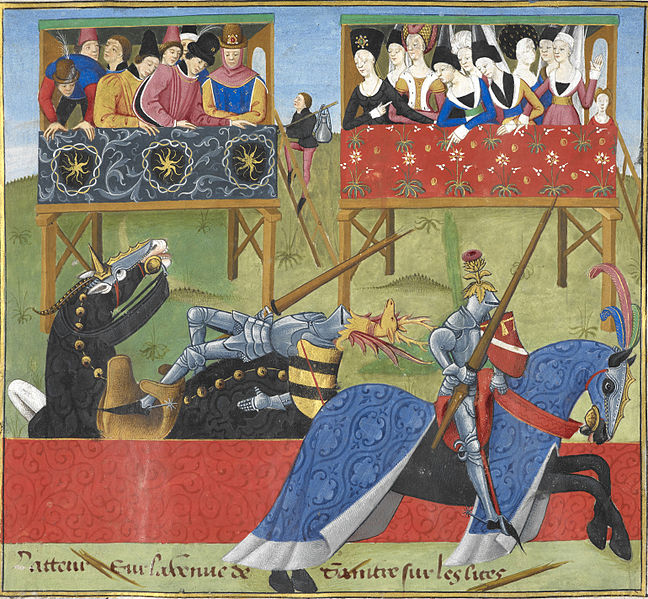
Obviously the guy on the left was not prepared to "assile and receive" his opponent, but we'll never know if it was because his stirrups were uneven. Also, note that the guy on the right is wearing a flower on his head.

So the next time someone mentions to you that your stirrups are uneven, you can tell them you're practicing for fighting in combat or a tournament. Just make sure it's your left one that's lower!

References:

Bedingfield, Thomas. The Art of Riding. London, 1584. Bedingfield was a Gentleman Pensioner to Queen Elizabeth I of England. He translated this book from the original Italian version (by Claudio Corte) at the behest of Henry Mackwilliams, another Gentleman Pensioner.

Wednesday, August 3, 2016

16th century dressage trivia: Sweat scrapers

I mentioned a couple of posts ago that I've been researching dressage in the 16th century. Currently I'm reading (and in some cases, attempting to translate) all the books I can get my hands on. There are probably fewer than 20 surviving books on horsemanship that were written before 1600, so I have hope that someday I'll get through them all. Unfortunately, the majority of them are in Italian, Spanish, or German, so it may take me a really long time (every try to read medival German in Gothic font? It makes for massive headaches). Luckily a few were translated into English, and that's what I've been focused on thusfar.

Every so often, I come across a particularly interesting bit of information that seems worth sharing, so I've decided to start a series of posts on random bits of trivia. The first installment has to do with sweat scrapers.

Did you ever wonder how sweat scrapers got their current form - a long, curved metal "blade"? (Ok, if you're fancy you probably have a rubber one with a handle... I'm talking about the plain aluminum ones.) It turns out that the first sweat scrapers were swords!
"You shall ever when he hath ridden and cometh in much sweating, presently have him into the Stable, and first rub him down with clean wisps. Then taking off his Saddle, with a Sword-blade whose edge is dulled, you shall stroke his neck and body clean over, leaving no sweat nor filth that can be gotten out..." (Markham p. 21)  
So if you ever lose your sweat scraper, just get out that trusty dulled sword you've got laying around. It'll work just fine!

Markham, Gervase. A Discourse of Horsemanship. London, 1593. (Leaflet of 1656 reprint shown)