
And then I started looking at them a little more closely, because there's something really, REALLY wrong with Paddy in that pic. Can you see it?
It's even more obvious here.
At the moment those pics were taken, Paddy's footfall pattern isn't even recognizable as a canter.
But that's not the only problem. Looking at the pics, it's pretty clear that I've completely given up actually riding him during the canter work. Look at my position in that last one - I've been pulled completely out of the saddle, and I'm standing in my irons. Here's another one where you can see how much I've lost my position. In this one I pretty much look like I'm hanging on for dear life and praying it will be over soon - which honestly, was not far from the truth.
And just in case you don't want to click through to the show pics, here's what I'm talking about (stills taken from video shot at home the week after the Championships):

See how he's about to land with his LF first instead of the the LF and RH at the same time?

Here it is again, and here's me being pulled out of the saddle instead of sitting down and back and actually RIDING.
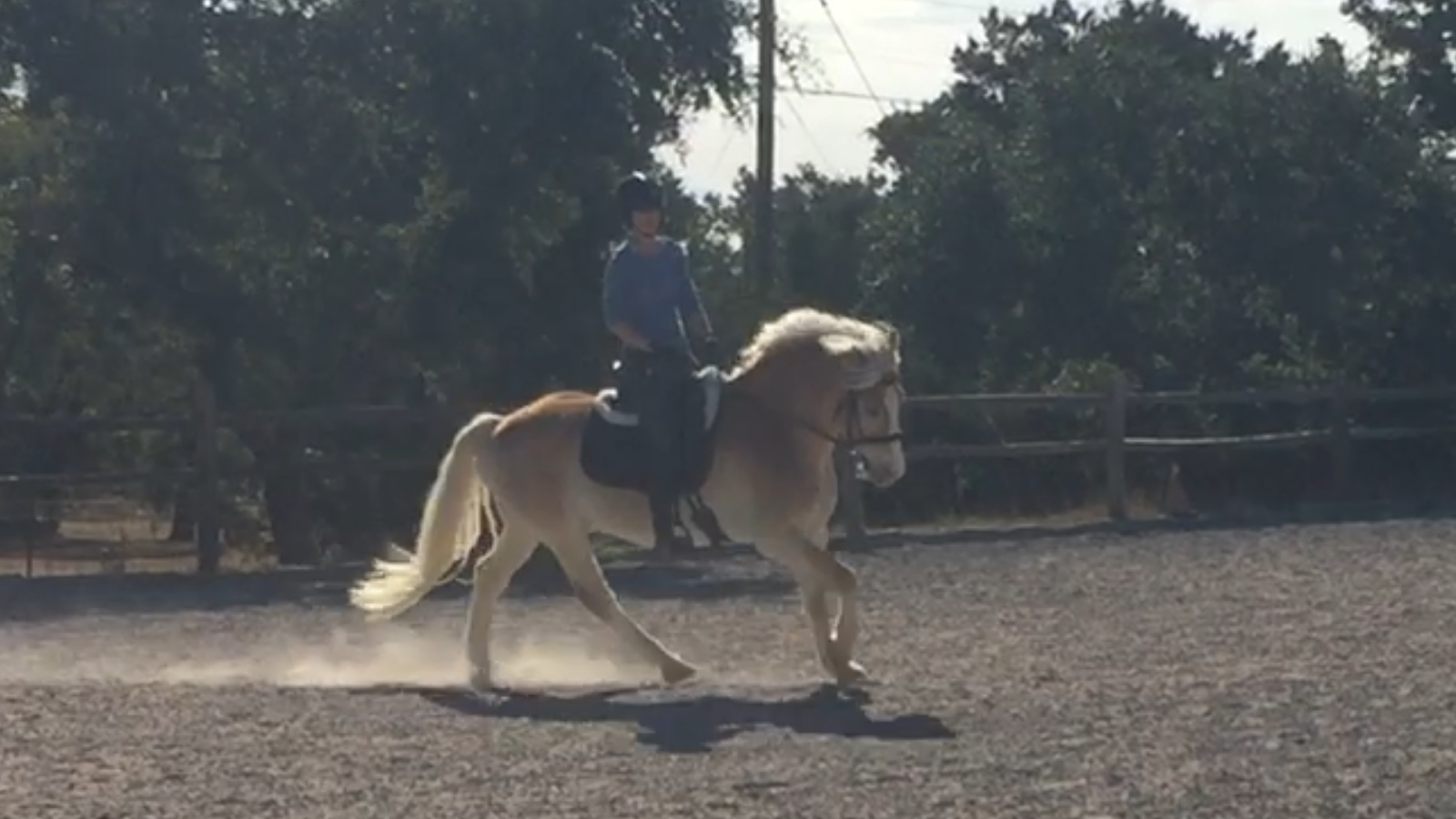
Still uneven, but better - and I'm actually sitting in the saddle trying to help him balance.
After doing some reading up on this (great article from Horse and Hound, Jan 2014, it's a must-read!), a four-beat canter of this type is not terribly uncommon. Apparently horses that land outside front first are doing so to get more support on the shoulder. The opposite of this is a horse who lands inside hind first, which happens when the horse has an extremely uphill canter and is these days considered a desirable trait.
So, where to go from here? Paddy's displacement is pretty extreme, and it's caused by lack of strength for him and lack of riding on my part - or too much riding, in the form of me pulling on his face and giving him some place to lean. The good news is that Paddy has a decent walk, so there's hope to fix it - or at least, improve it. For starters, I've got to learn to SIT the canter and not give in to despair! Transitions are always good - I couldn't get screen shots of the video, but usually the first few strides after a transition are very even and uphill. Also, and cantering in more of a "hunter" frame with his head a bit up and very light rein contact seems to encourage him to balance himself more. And my trainer has had us work on getting more "jump" in his hind end in the past, since he seems to get a bit sticky. Other suggestions are welcome!
Oh, and it would help if my horse were sound enough to canter! :)
